
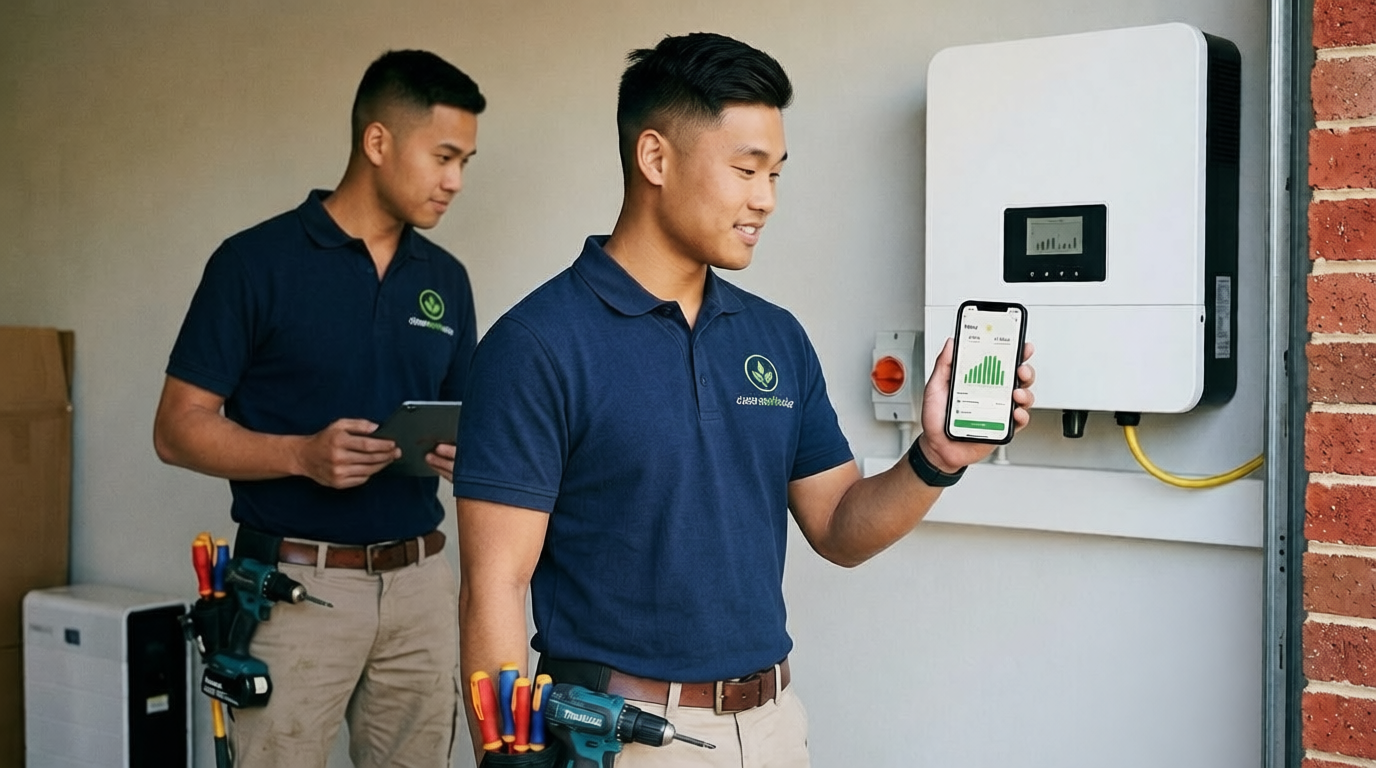
A solar monitoring system is a real-time tracking tool that shows how much power your panels produce, use, and store, usually through an app like Enphase Enlighten. For Hawkesbury and NSW homes, where dust, bushfire ash, and 38 degree summers can quietly cut solar output, a home solar monitoring system is the only reliable way to protect your savings.
A solar power monitoring system collects performance data from your inverter and panel sensors, then displays it on your phone, tablet, or computer through a cloud dashboard such as Enphase Enlighten, Sungrow iSolarCloud, or the Tesla app. Instead of guessing whether your panels are working, you see daily production in kWh, live power output, household consumption, battery state of charge for Tesla Powerwall 3 and SigEnergy batteries, and fault alerts.
A typical home solar monitoring system tracks:
This turns a passive rooftop install into a data-driven asset you can actually manage.
Solar monitoring matters because, without it, faults run undetected across entire billing quarters and the only visible signal is a higher power bill. Hawkesbury homes can quietly lose meaningful solar output to shading from new tree growth, dust and pollen build-up across the Hawkesbury Valley, inverter MPPT faults, or wiring issues from rodents and storm damage.
Common silent losses include:
A solar power monitoring system surfaces these issues the day they happen, not the day your power bill arrives.
The biggest benefit of monitoring is protecting the savings your system was sold on. NSW households typically save $800 to $2,500 per year on energy costs with solar, and even a small fault left running for one quarter can wipe out a meaningful chunk of that return.
You see exactly how many kWh your system is producing at any moment and can compare it against the design estimate from your installer.
Modern solar system monitoring solutions push instant alerts the moment output drops below threshold, so faults are fixed in days, not billing cycles.
Seeing live production lets you shift heavy loads such as pool pumps, hot water, and EV charging into peak solar hours, lifting how much of your generated power you use yourself rather than exporting it back to the NSW grid.
Continuous monitoring catches inverter heat issues and battery cycling problems early, reducing stress on the most expensive components in the system.
Every claim about your solar performance is backed by hard data you can export, share with your installer, or use for a warranty claim.
A solar monitoring system works in three steps: sensors collect data, a gateway transmits it to the cloud, and an app displays it. The hardware is already inside most modern installations.
For Hawkesbury properties on rural blocks with weak Wi-Fi signal, a 4G gateway or wired ethernet backhaul is usually the safer choice. Clean Earth Solar specifies the right gateway based on your house layout during the site assessment.
There are two tiers of solar monitoring: basic system-level monitoring that comes bundled with most inverters, and advanced panel-level monitoring that tracks every panel individually.
Feature | Basic Monitoring | Advanced Monitoring |
Data resolution | Whole system | Per panel |
Fault alerts | Inverter-level only | Panel, string, and inverter |
Shading diagnostics | No | Yes |
Weather impact analysis | No | Yes |
Consumption tracking | Optional add-on | Built in |
Typical hardware | Sungrow, Fronius, Growatt | Enphase IQ microinverters, SolarEdge optimisers |
Included as standard | Yes | Usually an upgrade |
For Hawkesbury homes with partial shading from gum trees or tank stands, advanced panel-level monitoring typically pays back its extra cost well within the warranty period through recovered output and earlier fault detection.
Most Hawkesbury solar owners only discover problems when a quarterly bill arrives noticeably higher than expected, often months after the fault first started. A solar power monitoring system eliminates that lag.
Faults monitoring routinely surfaces:
With Enphase microinverter systems Clean Earth Solar installs across Hawkesbury and greater Sydney, each panel reports independently, so a single faulty unit is identified the same day. When monitoring surfaces a fault, our Hawkesbury solar panel repairs team is dispatched to fix the issue before it costs you a full quarter of generation.
If you have invested in solar in Hawkesbury, Penrith, Blacktown, Castle Hill, the Blue Mountains, or anywhere in NSW, monitoring is the difference between guaranteed savings and silent loss. Without it, you are running a five-figure asset on hope.
A home solar monitoring system delivers:
Treat it as a health tracker for the most expensive thing on your roof. The Clean Energy Council recommends regular performance monitoring as best practice for every grid-connected system in Australia (Clean Energy Council solar consumer guide).
Solar monitoring lifts savings two ways: it protects the output you are already generating, and it helps you use more of that output yourself instead of exporting it cheaply.
NSW solar feed-in tariffs sit well below the price you pay to import power from the grid, as published in the IPART NSW retail electricity price review. That means every kWh you self-consume is worth several times more than every kWh you export. A monitoring app showing live production lets you:
For most Hawkesbury households, this lifts annual solar savings noticeably on top of the baseline return from the original installation.
Not every home is a perfect match, and that is okay. Homes with limited roof space, constant shading, or very low power usage may see smaller returns.
That said, residential solar panels suit far more homes today than they did even a few years ago. Technology has improved, systems are more flexible, and designs can be tailored to individual households.
The right solar system monitoring solution is the one that matches your inverter brand, your roof complexity, and your appetite for detail. The decision usually comes down to whether you need panel-level visibility.
Checklist before you choose:
Clean Earth Solar installs and configures monitoring across Enphase, Sungrow, Tesla Powerwall 3, and SigEnergy systems, and uses Enphase microinverter monitoring with an easy-to-use online portal as the default for new Hawkesbury homes.
The next wave of solar monitoring is predictive: AI-driven systems that forecast output 24 to 48 hours ahead, schedule battery charging against tomorrow’s weather, and automate appliance loads through the AS/NZS 4755 demand response standard.
Expect in the next 12 to 24 months across NSW:
Homes already running monitoring will be ready for these changes. Homes without it will need a hardware upgrade.
A solar monitoring system transforms a passive rooftop install into an actively managed energy asset that defends its own savings. For Hawkesbury and NSW homeowners, it is the cheapest insurance you can buy against silent underperformance.
Clean Earth Solar has installed over 1,000 solar systems across Hawkesbury and greater Sydney, totalling more than 6.5 megawatts of capacity since 2018. Every system is designed, installed, and monitored in-house by our SAA-accredited team and backed by a lifetime workmanship warranty. We are a SolarQuotes Gold-rated installer (Top 5 in NSW), AIKO Excellence Partner 2025, and Sungrow Elite Installer 2025. Browse our proof through our case studies or see all the NSW suburbs we service.
Every new install includes real-time monitoring through the Enphase portal, $0 upfront financing options, and a dedicated WhatsApp support group so questions are answered the same day.
Enphase Enlighten leads for panel-level detail, Sungrow iSolarCloud for hybrid systems, and the Tesla app for Powerwall batteries. Choice depends on installed hardware.
A solar monitoring system tracks panel output, household consumption, and inverter health in real time, then alerts you to faults so you protect your savings.
A retrofit Enphase Envoy or Sungrow communications module typically costs between $400 and $900 installed in NSW, depending on inverter compatibility and gateway type.
Basic monitoring tracks the whole system through the inverter. Advanced monitoring tracks every panel separately using microinverters or DC optimisers.
Yes, if your system has battery backup. Grid-only solar systems shut down for safety during a blackout, so monitoring stops until power returns.